Vanilla Ice Cream with Cherry Rhubarb Sauce
June 22, 2011
 Our ice cream maker does not get much attention in the winter. It sits lonely in the pantry, waiting to be remembered. It is not that ice cream is not just as good in the wintertime, but I seem to be busy making other desserts and rarely break it out. So the other day when our first hot days coincided with my son’s case of strep throat, I knew it was time to make some ice cream.
 The process of making homemade ice cream is simple. Cream, milk, sugar and eggs cook into a custard. The custard cools and then is poured into the ice cream maker to freeze. The difficult part is making an ice cream that does not have an icy taste. For a long time my go-to recipe was from Christopher Kimball’s The Dessert Bible. It is a great recipe and as usual his descriptions of the process and what can go wrong are extremely helpful. After reading a glowing review on food52 though, I decided to try a new recipe this time. I was not disappointed.
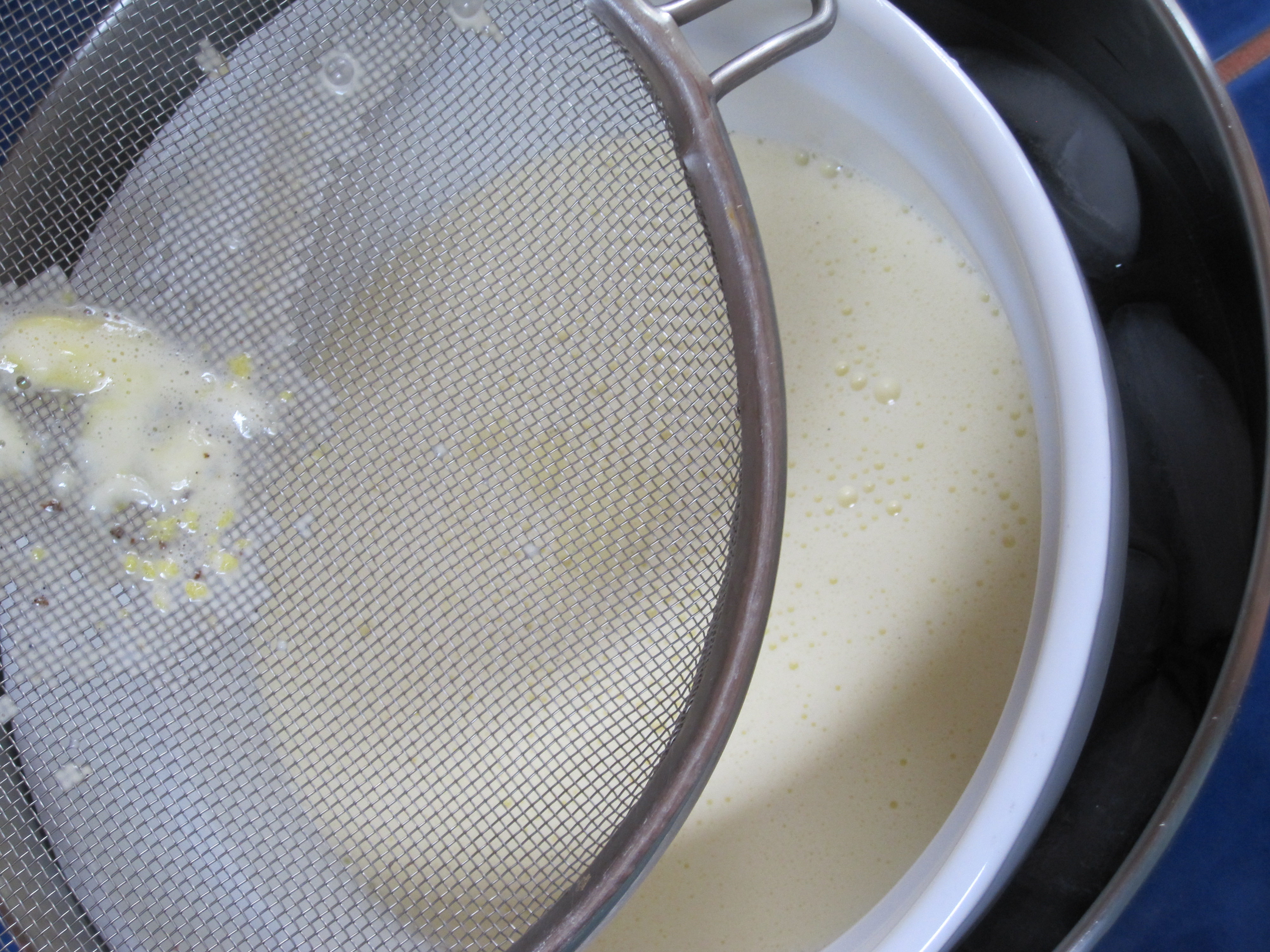 This Vanilla Ice Cream is rich and smooth with beautiful bits of vanilla seeds flecked throughout. It did not have the iciness that plagues so many homemade ice creams. Do not be tempted to reduce the fat here. Yes, this is a rich treat, but really you only need a small scoop. Enjoy yourself in moderation. If you really can not find a vanilla bean, you can use 1 teaspoon vanilla extract, but it will not be as good. If you are new to vanilla beans and have questions about how to scrape the seeds, check out Marissa’s great video on Food in Jars.
Strawberry Rhubarb Jam
June 16, 2011
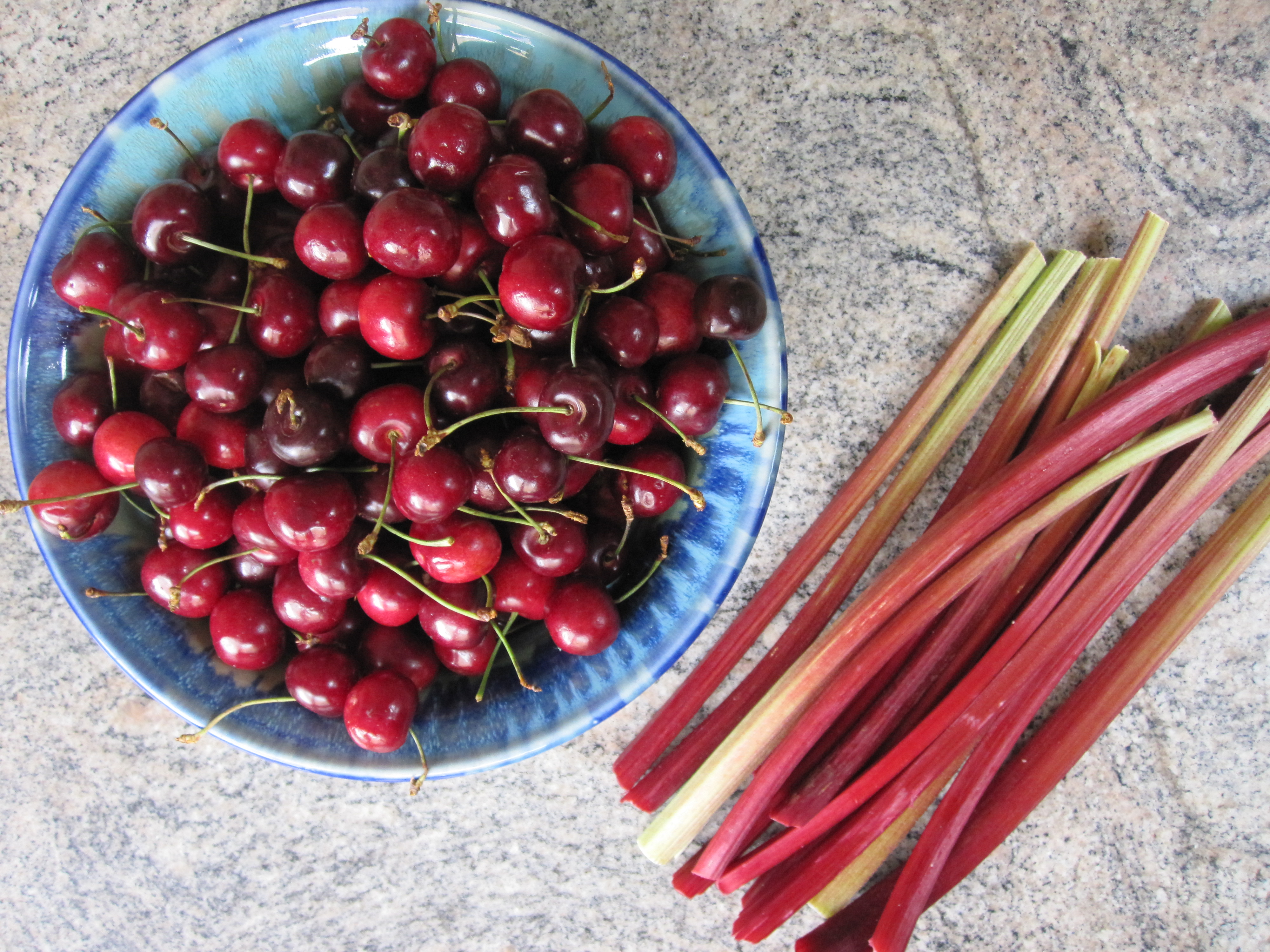
 Two weeks into my summer vacation, I had a serious itch to make some strawberry jam. The problem was everywhere I looked the strawberries were either over-sized and under-flavored or ridiculously expensive. On a tip from a friend, I headed out Highway 12 just outside Sebastopol to Lao’s Strawberry Stand. It took three tries: first time he sold out, second time simply closed, but the third time is a charm. It was well worth the trouble. These strawberries bear very little resemblance to the strawberries sold year-round at the supermarket. They are super small, bright red all the way through, and absolutely bursting with flavor. They literally made me swoon. It is such a pleasure to take the time to put up food when it is the best quality. I was giddy with the thought that we would be able to enjoy these beautiful strawberries all winter.
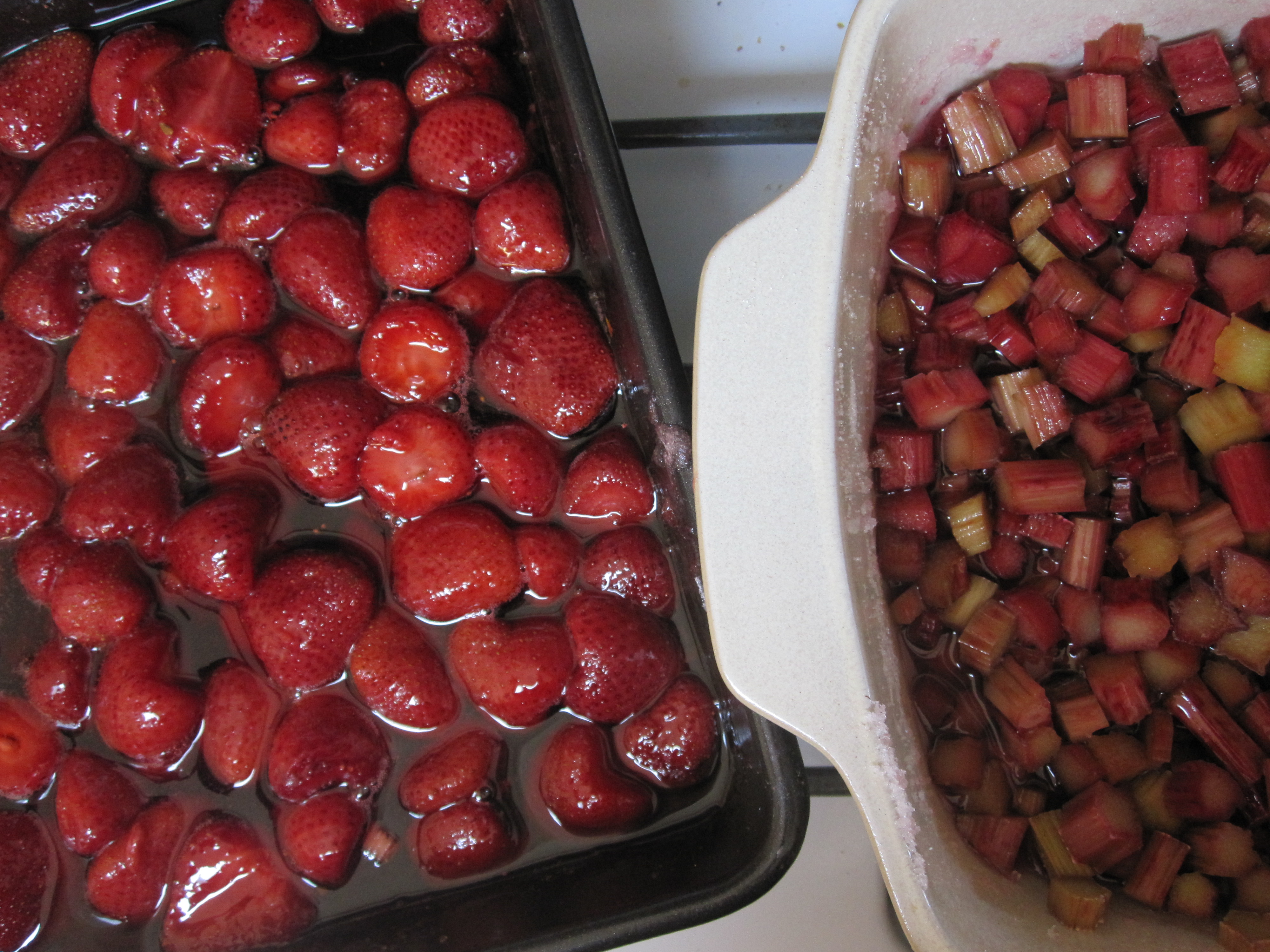
 The last few years, I have made strawberry rhubarb jam using low-sugar pectin and a standard process of heating the fruit and sugar to a boil, adding the pectin, and canning in sterile jars. It has always turned out good, but not great. Two problems I had were the strawberry and rhubarb both cooking down to a mushy pulp and the rhubarb turning a slightly greyish color. After reading Eugenia Bone’s method of slow roasting the fruit in a low oven, I had to try it.
Roasted Asparagus Pizza with Our Favorite Pizza Dough
June 13, 2011
 We are very serious about pizza in our house. I could go on and on about how my father hates cheese, especially melted cheese, and so I grew up in a poor, cheese-less house with an ever-present hunger for pizza. Or I could tell you about how I was lucky enough to marry a man who not only loves pizza as much as I do, but whose parents actually own a pizza restaurant. But no, I will not bore you with any more history, but you can see why pizza is now a mainstay of our diet.
 For many years now, my husband and I make pizza on Friday night. When I became pregnant with my first child, we wondered- What if the child doesn’t take to pizza? How will we cope? So week after week through the pregnancy, I dutifully ate my pizza hoping to accustom our child to the flavors of our home. Needless to say, it worked. The first, and now second child, have both folded neatly into our end of the week routine.
Of course, good pizza is only as good as its dough. My recipe binder records our history with pizza dough. Following our pizza timeline, there is a progression of one dough recipe morphing into another, our trials and experiments with recipes from countless sources. I am confident to say that the recipe that follows is excellent. We have eaten it on a weekly basis for the last year. The texture and flavor are outstanding. In addition, the dough makes enough for 3 large pizzas. We make the dough once and freeze two dough balls for use in future weeks. We all agree, the dough is best after being frozen. If time allows, make the batch and freeze all three dough balls. Just remember to take them out of the freezer a few hours before you want to make your pizza.
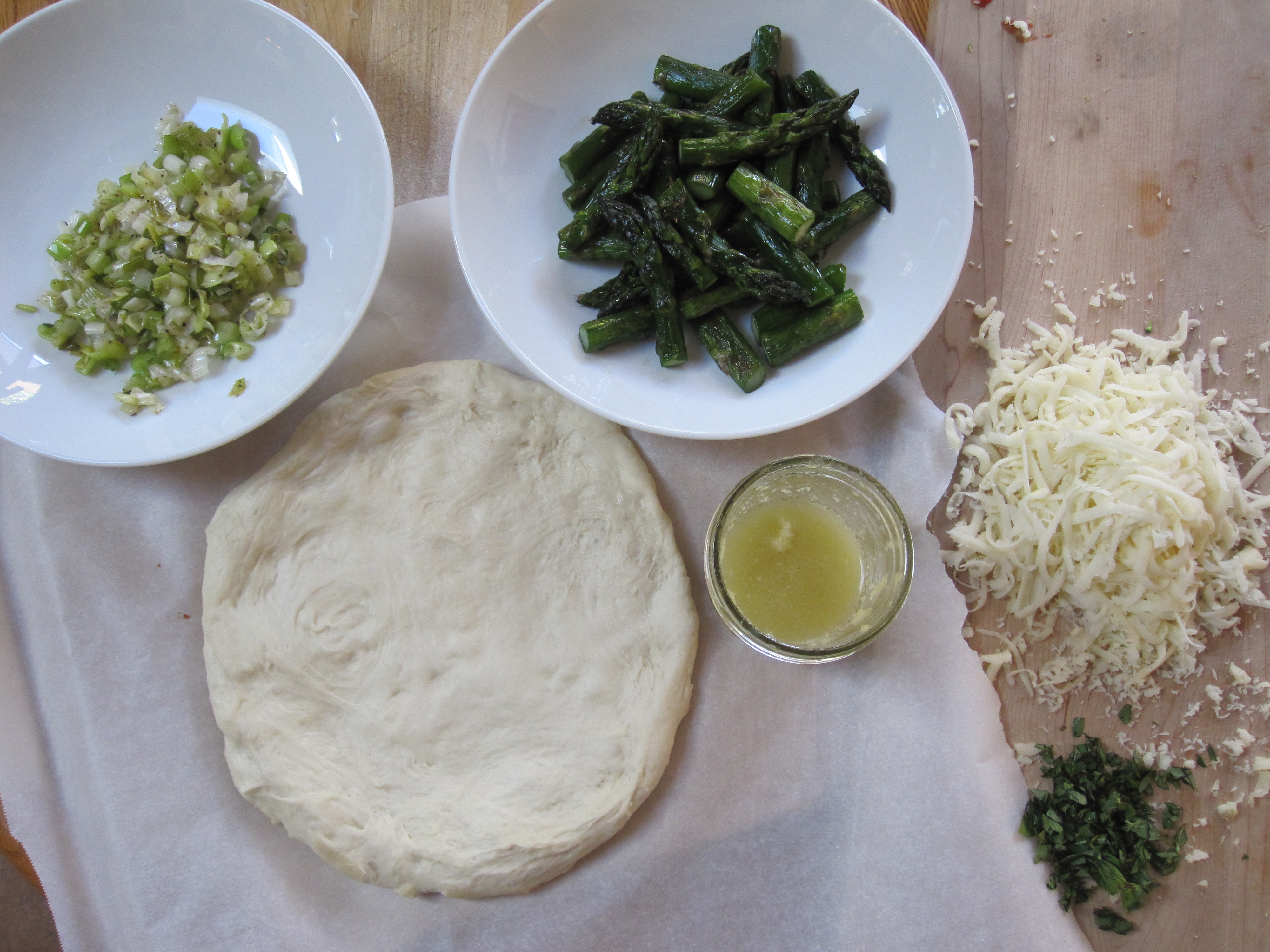 Generally I make the dough and prep the toppings, then my husband tosses the dough while we all gather around to cheer. The kids top the pizzas to their liking and off it goes into the oven. One of the reasons we can get away with eating pizza every Friday is that we rarely make the same pizza twice. I like to top the pizzas with whatever is fresh and seasonal.
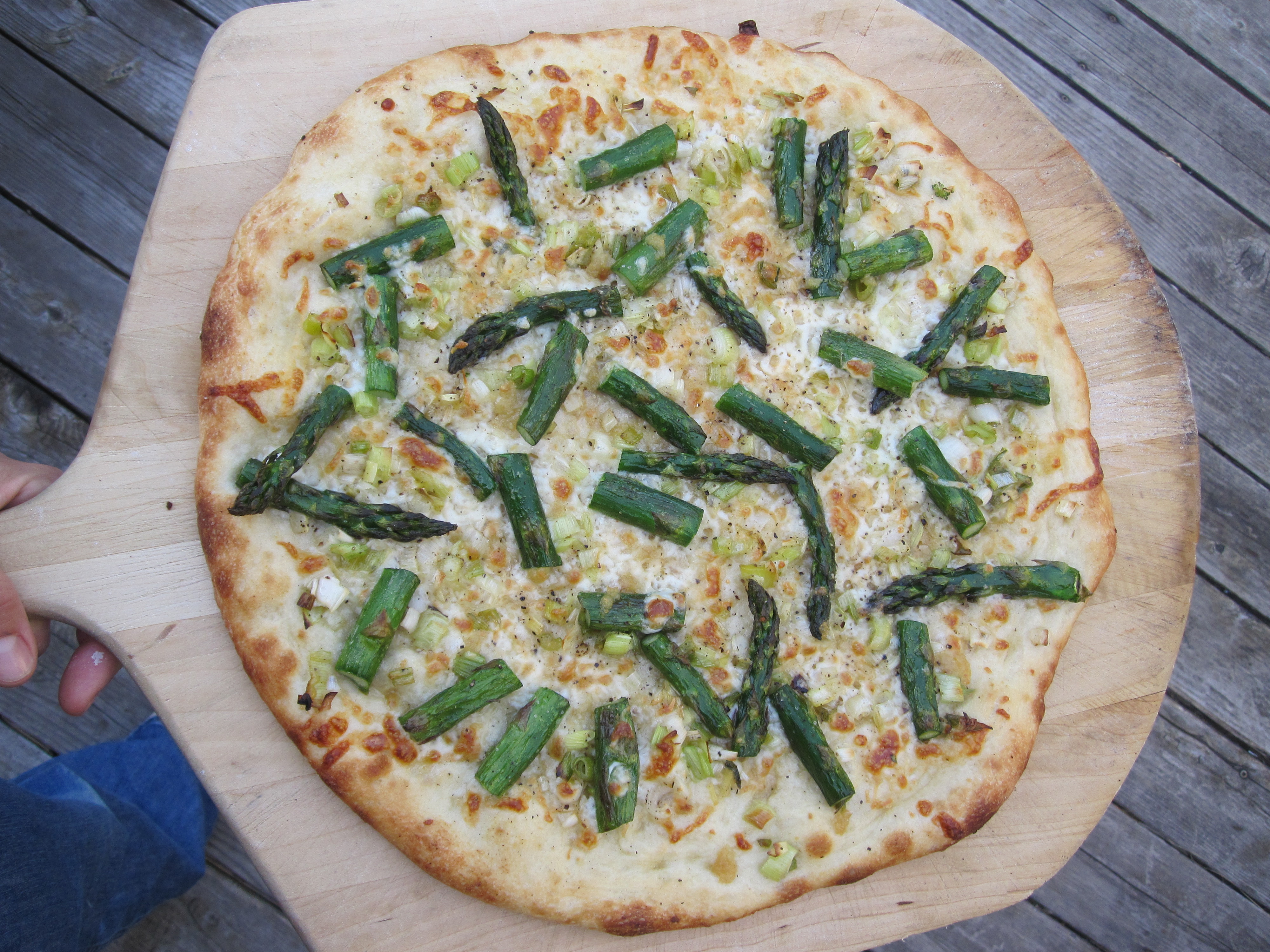
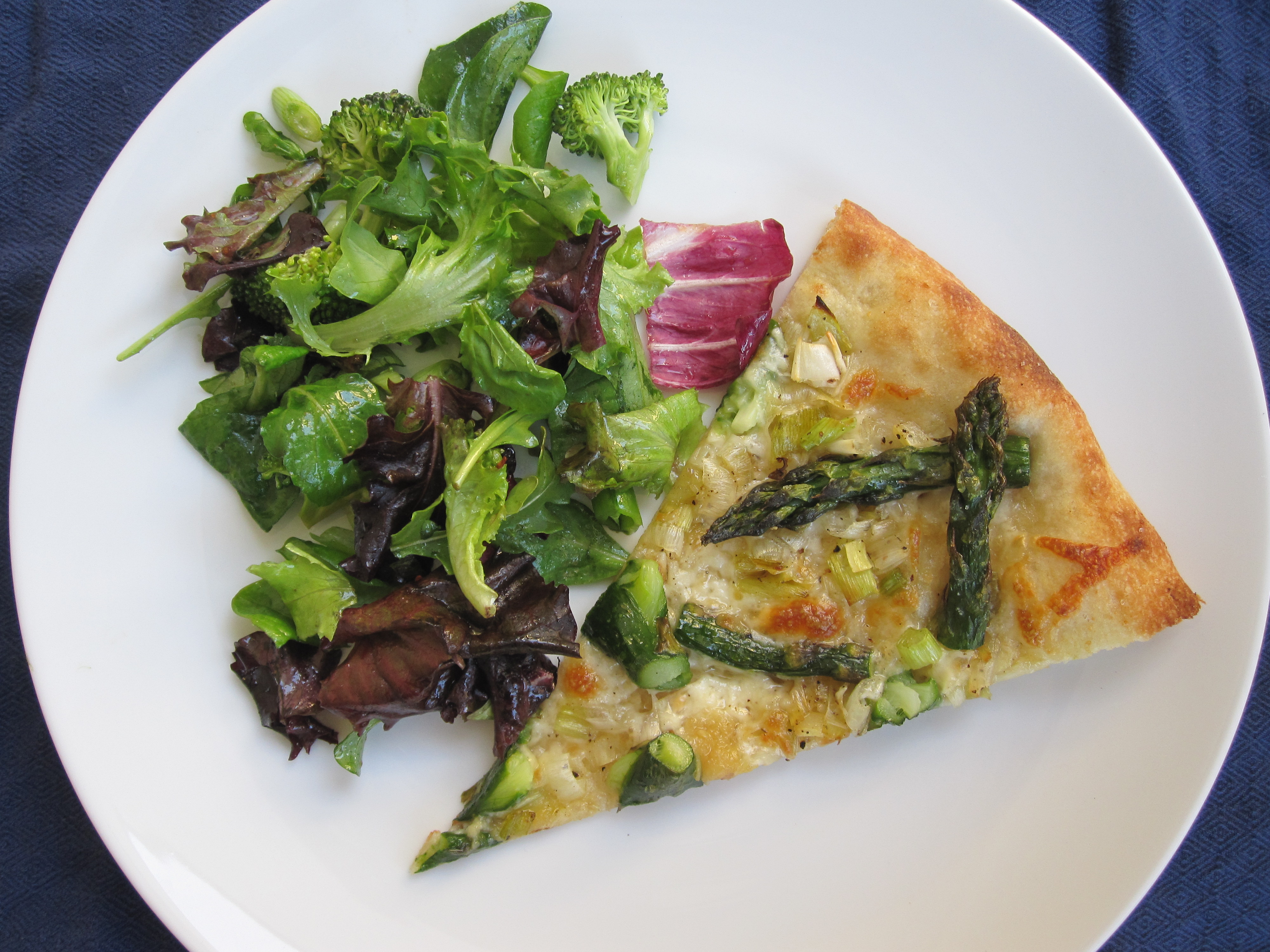 The Roasted Asparagus Pizza is perfect for the late spring. It is simple and light. We just harvested an arm-load of leeks from the garden, so I sliced and sautéed them until they were soft. Thinly sliced onions would also go well. I roasted the asparagus in the oven before tossing it on the pizza. Instead of a red sauce, the dough receives a generous brush of roasted garlic infused olive oil and a seasoning of salt and pepper. A thin scattering of cheese binds the toppings. All in all, this came to be a beautiful, light springy pizza. Add a shake of pepper flakes if you like it spicy.
Our Favorite Pizza Dough
Makes enough for 3 10-inch pizzas
adapted from Bon Appetit
Note: You will need to start this dough the night before you wish to use it. It freezes very well. Consider making it well ahead, freezing it, and taking it out of the freezer a few hours before you want to use it.
the sponge
1 cup lukewarm water
1 teaspoon active dry yeast
1 cup all-purpose flour
Mix together all ingredients in the bowl of a standing mixer and cover with a plate or plastic wrap. Let sit 8 hours or overnight on the counter.
the dough
1 1/2 cup lukewarm water
2 teaspoons salt
3 1/2 teaspoons active dry yeast
6 cups (or more) all-purpose flour
Add water, salt, and yeast to the sponge. Mix thoroughly with dough hook. Add flour, one cup at a time, with mixer on low. Continue to knead dough until it has formed a uniform elastic mass. The dough should be soft and tacky, but not sticky. Turn dough out onto a lightly floured board and knead briefly by hand to form a smooth ball. Place ball in an oiled bowl and cover with a plate or plastic wrap. Chill dough for a total of six hours, kneading down the dough once it has doubled (2-3 hours).
1 1/2 hours before baking, take dough from refrigerator and set on the counter. Knead dough gently and cut into 3 equal pieces. (At this point I usually take 2 of the dough balls and place them each in a quart size freezer zipper bag. I label and freeze them for next Friday’s pizza.) Cover the dough balls you intend to bake off that day and let rest until almost doubled (1-2 hours).
Preheat oven to 500 degrees 45 minutes before baking. Place a pizza stone in oven to preheat as well. Cover a pizza peel (or large cutting board) with parchment paper. Gently pull and flatten dough evenly to form a 10 inch circle. Place dough round on the parchment paper. Top as desired. Slide pizza on parchment onto the pizza stone. Bake 12-15 minutes until cheese is melted and bubbly and the bottom of the crust does not bend when you lift the edge of the pizza with the pizza peel. Remove parchment paper after 5 minutes of cooking. (The parchment can be used for the next pizza if you are making multiple.) Place cooked pizza onto cooling rack immediately. Allow to cool 2-3 minutes before cutting. Slice pizza and serve.
Here is a printer-friendly version of the recipe: Our Favorite Pizza Dough
Roasted Garlic Pizza Sauce
1/2 of a garlic bulb
1/2 cup olive oil
Preheat oven to 350 degrees. Slice the tips off of garlic bulb (the pointy end, not the root end). Drizzle with 1 tablespoon olive oil. Wrap the bulb in foil. Bake at 350 degrees for 30 minutes or until the cloves are soft. Remove garlic from foil. Squeeze garlic from each head into a small blender jar (a mason jar works well here, just attach the blade and base to the jar). Blend with remaining olive oil. Brush over pizza, then top as desired.
Here is a printer-friendly version of the recipe: Roasted Garlic Pizza Sauce
Roasted Asparagus Pizza
makes 1 10-inch pizza
1 ball of Our Favorite Pizza Dough (1/3 of the recipe)
3 tablespoons Roasted Garlic Pizza Sauce
10 spears asparagus, cut into 1 inch lengths (about 2 cups)
1 cup thinly sliced leeks
2 tablespoons olive oil
salt and pepper
1 cup grated mozzarella cheese
1/4 cup grated parmesan or Asiago cheese
1 tablespoon minced fresh oregano (to add after pizza is removed from the oven)
red pepper flakes (optional)
After you have roasted the garlic for the Roasted Garlic Sauce, turn up the oven to 500 degrees. Toss the asparagus with one tablespoon of olive oil. Season liberally with salt and pepper. Place asparagus on a baking sheet and cook at 500 degrees for 7 minutes. Meanwhile, sauté sliced leeks with the remaining 1 tablespoon of oil over medium-low heat. Cook until leeks are very soft, but not brown. Spread Roasted Garlic Sauce over a 10-inch round of Our Favorite Pizza Dough, be sure to spread all the way to the edge. Top with cheese, leeks, and asparagus. Grind pepper over the pizza and slide into the oven. Bake 12-15 minutes until cheesy is melted and bubbly and the bottom of the crust does not bend when you lift the edge of the pizza with the pizza peel. Place cooked pizza onto cooling rack immediately. Top with oregano. Allow to cool 2-3 minutes before cutting. Slice pizza and serve.
Here is a printer-friendly version of the recipe: Roasted Asparagus Pizza
This post was submitted to Yeastspotting.
You may also like:


Sea-Salted Chocolate Walnut Brownies
June 8, 2011
 There is a rule in our house: if I am going to make something decadent, there has to been people to share it with (preferably out of the house.) Sounds sensible, doesn’t it? The problem is that from an early age I have learned to find the loophole in almost every rule. And here is the loophole: my brain is always inventing excuses to make decadent things and then share them. My ear is cocked for someone celebrating a birthday, a friend with a new child, a neighbor in the middle of a remodel, an unexpected house guest, you get the picture. So when a friend mentioned they needed a dessert for a moving party, I immediately jumped on the idea of making these brownies!
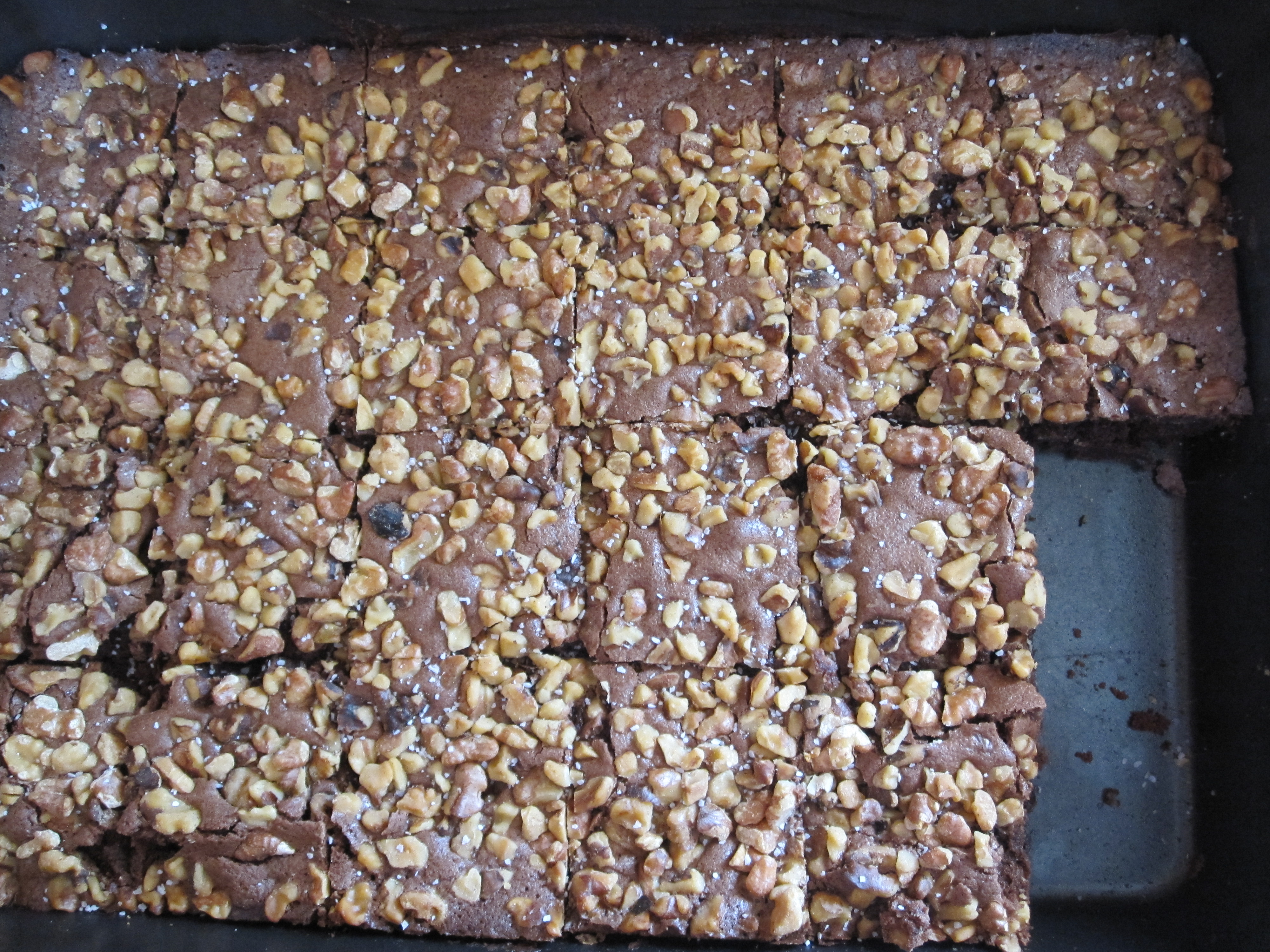 I adapted a recipe from Martha Stewart Living Desserts. Her original recipe is excellent. In fact it is so good that I have not been able to bring myself to try a different recipe since I discovered hers years ago. Martha’s recipe calls for baker’s chocolate but, I swapped that out for unsweetened ground cocoa because that is what I prefer to have on hand. She also calls for a half cup of chocolate chips, which are a nice addition, but I feel they detract a bit from the phenomenal texture and taste of the brownie itself. I left them out. Taking a tip from Cook’s Illustrated, the walnuts are sprinkled on top of the brownie instead of mixed in the batter. This prevents the top from cracking when you slice the brownies. It also makes it clear that to anyone with allergies that the brownies contain nuts. As a finishing touch, I sprinkle coarse sea salt over the top of the warm brownies. This adds a nice salty contrasting crunch as well as gives a little sparkle to the brownies.
Roasted Garlic Lemon Chicken
June 5, 2011
 What a fabulous week it has been. It is officially summer for me now. After my 17 years of schooling and then 8 years of teaching high school science, the rhythm of the academic calendar is deeply rooted in my bones. So even though the weather is unseasonably soggy and gloomy, deep down inside I still know that- School’s…out for summer!!! To make the upcoming break all that much more sweet, on my last day of school I found out that my Sausage and Kale Dinner Tart won the contest for the Best Dirt Cheap Dinner on food52. What an incredible honor! I am a huge fan of food52. It is one of my go-t0 sites for great recipes and culinary inspiration from the many fabulous cooks that contribute to the site. What a great way to start the summer and kick off my serious cooking and canning season!
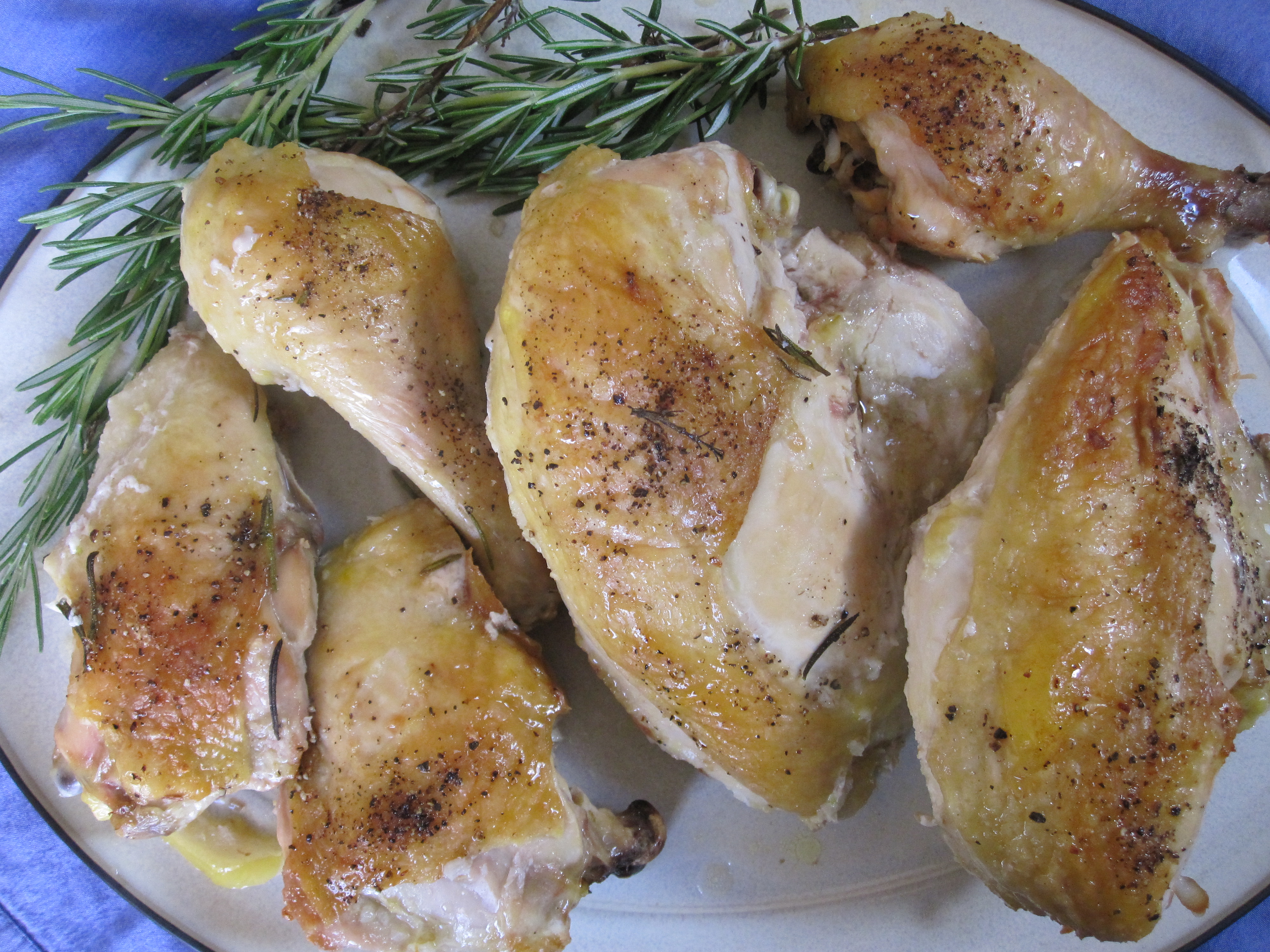
 As a celebratory meal, I made Roasted Garlic Lemon Chicken. I love how chicken is both a perfect special occasion meal, yet inexpensive and quick enough to be perfectly suited for a weeknight as well. This particular recipe is a regular in our rotation. It is easy to adapt by changing the herbs, I call for rosemary here, but you could also use thyme, oregano, basil, or forgo the herbs altogether and add a touch of curry paste to the garlic mixture instead.
 Roasted Garlic Lemon Chicken can be made with any pieces of chicken you prefer. The original recipe calls for chicken thighs. Since I often buy chickens whole and part them myself, I have always made it with a whole parted chicken. When arranging the pieces in the pan, I put the breasts in the center and dark meat pieces around the outside. All the pieces cook up perfectly! Preparing this meal is incredibly simple. Spread garlic paste over the chicken pieces and under the skin, then roast the chicken until the skin is browned and crackly, but the meat is super tender and moist. The herbs perfume the meat and the lemon roasts and caramelizes lending a rich, lemony flavor. Degrease the juices and reduce to make a flavorful sauce to pour over the sliced meat. Dress it up or dress it down, this chicken is great for any occasion.
Roasted Garlic Lemon Chicken
adapted from Bill Devin at Fine Cooking
via The 140 Best American Recipes by Fran McCullough and Molly Stevens
Serves 6
the garlic paste
2 garlic cloves
pinch of salt
3 tablespoons olive oil
Mince garlic with a knife. Sprinkle salt over the garlic and the flat blade of your knife to grind the garlic into a fine paste. Transfer paste to a bowl. Drizzle oil over paste slowly while whisking vigorously until mixture is uniform and emulsified. (If it does not emulsify, do not worry. The chicken will still turn out great.)
the chicken
1 5-pound chicken, parted
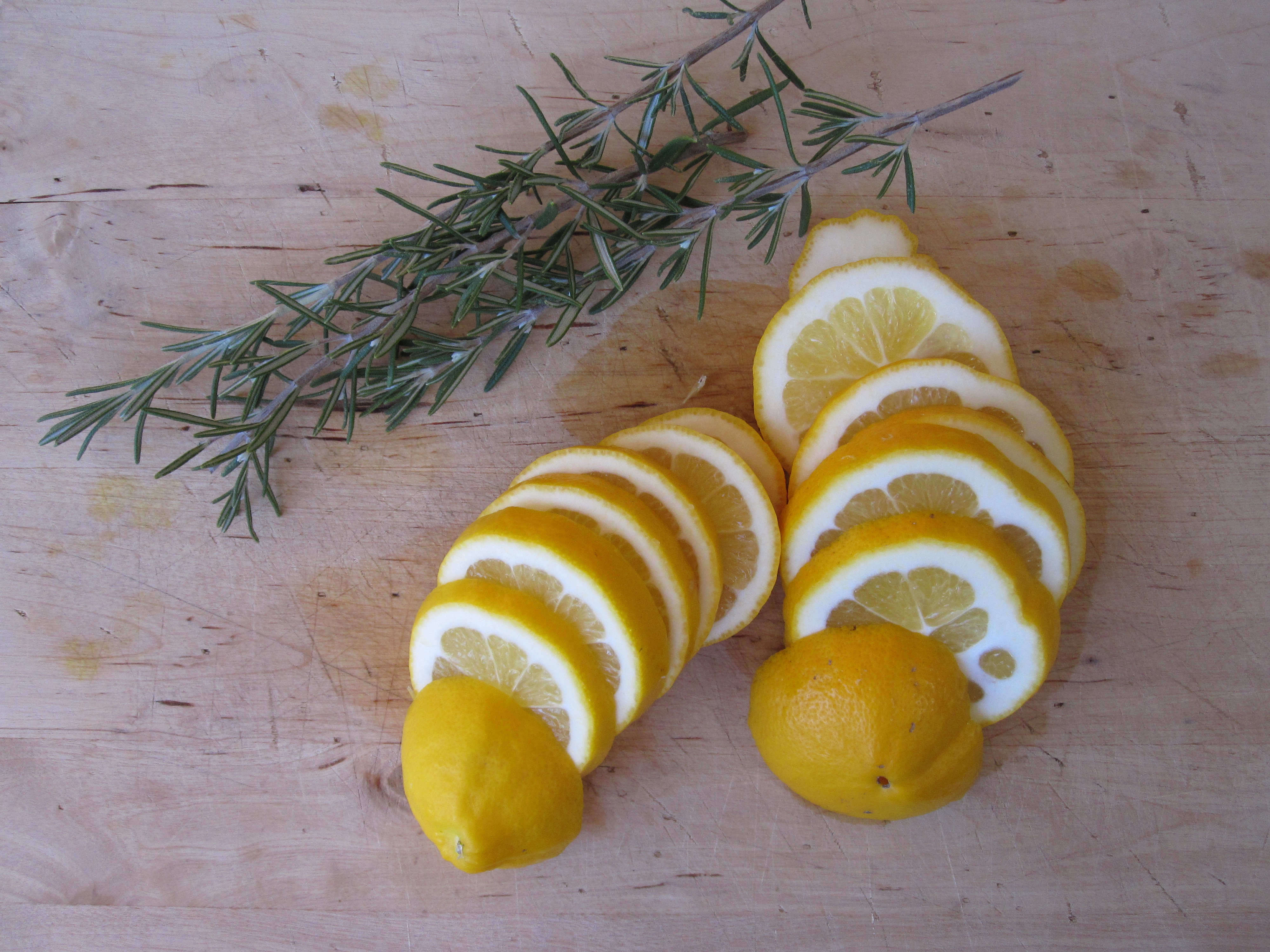
2 large lemons, sliced into 1/4 inch slices
1 bunch rosemary (6 4-inch pieces)
2 tablespoons white wine
freshly cracked black pepper
Rub the chicken pieces with the garlic paste thoroughly on both the outside and inside of the skin. Cover and let chill 2 hours to overnight. The longer you let it chill, the more flavorful it will be.
Preheat the oven to 425 degrees and set rack in the middle of the oven.
Using a 9 x 13-inch baking dish, lay lemon slices evenly over the bottom. Arrange rosemary sprigs over the top of the lemon and chicken pieces, skin side up, on top of the rosemary. The breasts should be in the center since they cook the fastest. Arrange the dark meat pieces around the outside.
Bake the chicken for 45 minutes or until the skin is browned and crisp and the meat is cooked thoroughly.
Transfer the chicken pieces to a platter and cover loosely with foil. Strain any accumulated juices into a small saucepan. Skim fat from the top. Heat remaining juices over medium to create a simmer. Add white wine and black pepper to taste. Simmer until sauce is reduced by 1/3. Serve meat as whole pieces or sliced with the flavorful sauce.
Here is a printer-friendly version of the recipe: Roasted Garlic Lemon Chicken
You may also like:
Biscuit-topped Chicken Pot Pie
Orange Quinoa with Almonds, Olives and Feta


 My Pantry Shelf